

Lofthouse Cookie Dupe (Soft, Fluffy + Made with Einkorn Flour)

April 21, 2025
super easy
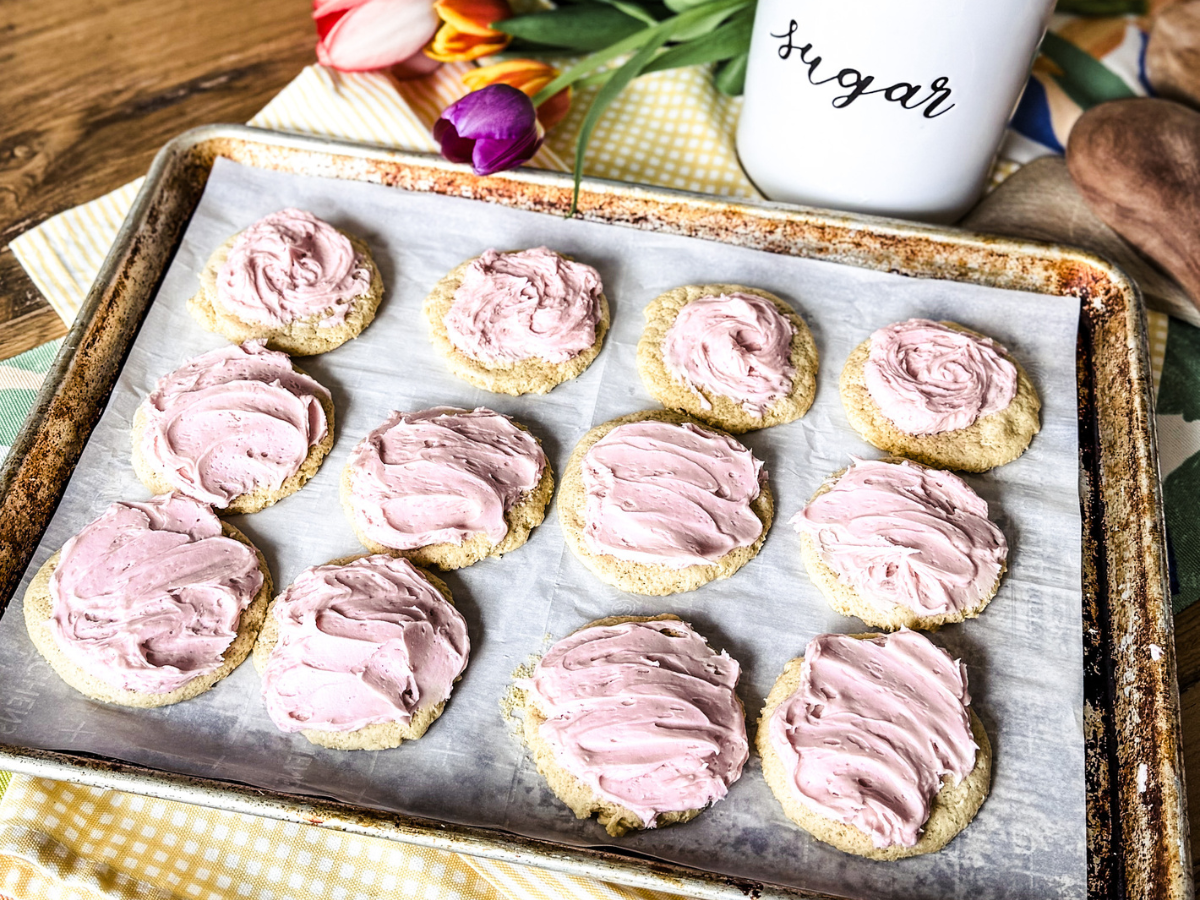
These Lofthouse cookie dupes are soft, fluffy, and topped with a thick swirl of vanilla bean buttercream — a homemade take on the grocery store classic made with einkorn flour, arrowroot, and real ingredients you actually recognize.
Whether you’re baking with your kids on a weekend afternoon or bringing a batch to a spring get-together, these are the kind of cookies that make everyone reach for seconds. And the best part? You don’t have to choose between fun food and food you feel good about serving.
Why This Recipe Works
If you grew up in the 90s you know exactly what a Lofthouse cookie is. Round, pillowy, frosted in pastel buttercream and covered in sprinkles — they showed up at every classroom birthday party, every holiday gathering, every checkout lane display at the grocery store. They were impossible to walk past.
The problem is the actual ingredient list. Sugar, palm oil, soybean oil, corn starch, artificial flavor, sodium propionate, and a list of food dyes that is more like a science experiment than food. Not exactly what you want to hand to your kids on a regular basis.
This recipe keeps everything that makes a Lofthouse cookie worth eating — the pillowy texture, the sweet frosting, the nostalgic softness that makes you feel like a kid again — and builds it from ingredients that you can actually pronounce. Einkorn flour instead of refined all-purpose, arrowroot instead of cornstarch, organic sour cream, real vanilla bean paste in the frosting.
The texture is the part that took the most attention to get right. Lofthouse cookies aren’t sugar cookies — they’re softer, more cake-like, almost cloud-like when you bite into them. Getting that texture at home without the industrial additives requires a few specific technique steps: sifting the dry ingredients three times, whipping the eggs and sugar until bubbly, folding rather than mixing, and chilling the dough for a full hour and a half to two hours before baking. Every one of those steps is important.
What Makes This Different from Other Lofthouse Dupes
Every other Lofthouse copycat recipe online uses standard all-purpose or cake flour. This one is made with all-purpose einkorn flour — which gives the cookies a subtly different flavor and a texture that feels lighter and more tender than a conventional flour version.
Einkorn is an ancient grain with a weaker gluten structure than modern wheat, which actually works in your favor for a cookie like this. Less gluten development means a softer, more delicate crumb — exactly what a Lofthouse cookie is supposed to have. The einkorn also adds a very faint nutty warmth that plays beautifully against the vanilla and almond extract.
The arrowroot is the other swap worth noticing. Most Lofthouse copycat recipes use cornstarch as their starch component for softness. Arrowroot does the same job — it keeps the cookies tender and helps them hold their shape — without the processing that comes with commercial cornstarch. It’s a clean, easy swap.
Key Ingredient Notes
All-purpose einkorn flour. 2¾ cups, sifted three times. Jovial Foods all-purpose einkorn is what this recipe was developed with and what I recommend. The triple sifting isn’t optional — it aerates the flour and removes any lumps that would otherwise create dense spots in the cookie. Don’t skip it.
Arrowroot. 2½ teaspoons, sifted with the flour. This is the clean swap for cornstarch — it keeps the cookies soft and tender and helps them hold their round shape as they bake. Tapioca starch works as a direct substitute if that’s what you have.
Baking powder and baking soda. Both, in small amounts. This combination is what gives Lofthouse cookies their signature cakey rise — not the crisp, flat spread of a classic sugar cookie. Both are necessary and neither can be substituted for the other here.
Cream of tartar. ¼ teaspoon, whisked with the eggs and sugar. Cream of tartar stabilizes the whipped egg mixture and contributes to the soft, fluffy texture by preventing the sugar from crystallizing as it bakes.
One whole egg plus one egg white. Both at room temperature. The whole egg gives richness and structure; the additional egg white adds lift and lightness. This combination is part of what makes the texture closer to cake than to a traditional sugar cookie. Room temperature is important — cold eggs don’t incorporate as evenly.
Organic sugar. One cup. Standard granulated sugar for the cookie base. Organic cane sugar measures and behaves identically to conventional granulated sugar.
Organic sour cream. ¼ cup, folded in gently. Sour cream is what makes Lofthouse cookies so soft and moist. The fat and acidity activate the baking soda and contribute to that pillowy texture. Don’t skip it and don’t swap it for yogurt without expecting a slightly different result.
Vanilla extract and almond extract. Both. The almond extract is the detail most people can’t place when they taste a Lofthouse cookie — it’s not obviously almond-flavored, but it adds a warmth and depth that vanilla alone doesn’t quite achieve. ¼ teaspoon is exactly the right amount — enough to matter, not enough to taste.
For the buttercream — vanilla bean paste. 1 tablespoon. Vanilla bean paste gives the frosting a more complex, rounded vanilla flavor than extract alone, and you get the beautiful flecks of vanilla bean throughout. It’s a small detail that makes the frosting taste genuinely special. Extract is works too as a substitute if that’s what you have.
Variations and Substitutions
Color the frosting for any season. Pink for Valentine’s Day, pastel blue or yellow for Easter, orange for Halloween, red and green for Christmas. I use natural food coloring.
Add sprinkles. Rainbow jimmies are the classic Lofthouse move and they look exactly right on these. Press them gently onto the frosting right after spreading so they stick before it sets. SuperNatural is my favorite sprinkle.
Lemon version. Add 1 teaspoon of lemon zest to the cookie dough and swap the almond extract for a little additional lemon zest. Color the frosting yellow. A spring crowd-pleaser.
Skip the almond extract. If anyone has a nut allergy, simply leave it out and increase the vanilla to 2 teaspoons. The cookies are still excellent.
Tapioca starch instead of arrowroot. A direct, equal-amount swap. Both are clean starches that behave the same way in this recipe.
Regular all-purpose flour. If you don’t have einkorn, use regular all-purpose flour at the same amount. The cookies will be slightly less tender and won’t have the subtle nutty flavor, but the recipe works.
How to Make the Buttercream Frosting
- Beat the butter. In the bowl of a stand mixer with the paddle attachment, or with a hand mixer, beat 1 cup softened butter until smooth and creamy. The butter needs to be genuinely softened — not melted, not cold from the fridge. Leave it at room temperature for at least an hour before starting.
- Add the vanilla bean paste. Add 1 tbsp vanilla bean paste and mix until combined.
- Add the powdered sugar gradually. With the mixer on its lowest setting, add the 5 cups organic powdered sugar one cup at a time. Adding it all at once causes a powdered sugar cloud and uneven mixing. Low speed is important here.
- Add the milk. Once the powdered sugar is fully incorporated, add 3 tbsp milk and mix until smooth. Add more milk a teaspoon at a time if you want a softer, more spreadable consistency. The frosting should be thick enough to hold its shape when swirled but soft enough to spread easily.
Set aside while the cookies bake and cool.
How to Make Lofthouse Cookie Dupe
- Sift the dry ingredients — three times. In a bowl, sift together the 2¾ cups all-purpose einkorn flour, ½ tsp baking powder, ½ tsp baking soda, 2½ tsp arrowroot, and ½ tsp salt. Sift the whole mixture three full times and set aside. This step is what creates the light, airy texture — don’t shorten it.
- Whip the eggs, sugar, and cream of tartar. In a large bowl, whisk together the 1 egg, 1 egg white, 1 cup organic sugar, and ¼ tsp cream of tartar. Whip for about 90 seconds until the mixture is bubbly, pale, and noticeably fluffy. A hand whisk works fine here — you’re not looking for stiff peaks, just genuine aeration.
- Fold in the wet ingredients. Using a spatula — not a whisk or mixer — fold in the ¼ cup organic sour cream, 1½ tsp organic vanilla extract, and ¼ tsp organic almond extract. Mix well but don’t overwork it. Folding keeps the air you’ve built into the eggs intact.
- Add the flour in thirds. Add the sifted flour mixture in three additions, folding gently with the spatula after each one. Mix until just combined — a few small streaks of flour are fine going into the fridge. Overmixing develops gluten and makes the cookies tough rather than tender.
- Chill the dough. Cover the bowl with a tea towel or plastic wrap and refrigerate for 1½ to 2 hours. The dough will be quite soft before chilling — this step is what makes it scoopable and allows the cookies to hold their shape during baking. Don’t rush this.
- Preheat and prep. Preheat the oven to 375°F. Line a baking sheet with parchment paper.
- Scoop and flatten. Using a medium cookie scoop, scoop 12 portions of dough onto the parchment-lined baking sheet, spaced about 2 inches apart. Tear a small piece of parchment paper from the roll. Place it on top of one dough ball, then press the flat bottom of a glass down firmly to flatten the cookie to ¼ to ½ inch thick. The parchment between the glass and the dough prevents sticking. Repeat for each cookie.
- Bake for 7–8 minutes. Watch closely. These cookies should come out when they just barely lose their glossy sheen on top — they will not brown and should look slightly underdone. They firm up as they cool. A single minute too long makes them dry instead of soft.
- Cool completely before frosting. Let the cookies cool on the baking sheet for at least 15 minutes before frosting. Frosting warm cookies causes the buttercream to melt and slide off.
- Frost generously. Swirl the buttercream onto each cooled cookie with a butter knife or the back of a spoon. Add sprinkles immediately while the frosting is still soft.
How to Freeze
These freeze remarkably well — frosted and ready to go.
To freeze: Let the frosted cookies set at room temperature for 15 minutes. Place on a parchment-lined baking sheet and freeze for a minimum of 2 hours and a maximum of 4 hours, until the frosting is fully firm. Transfer to a freezer-safe Ziploc bag or airtight container and freeze for up to 2 months.
To thaw: Place on the counter for 20–30 minutes. The frosting softens back to its original texture as it comes to room temperature. These are genuinely one of the better cookies to have stashed in the freezer — pull a few out before a playdate or whenever you need something that feels special without any last-minute work.
Expert Tips
Triple sifting is the texture secret. It’s the step that feels fussiest and makes the biggest difference. Einkorn flour is denser than conventional flour — aerating it three times is what gives you that light, pillowy cookie rather than a flat, slightly dense one.
Fold, don’t mix. Once the sour cream goes in and especially once the flour goes in, switch to a spatula and fold everything together. The whipped eggs are doing structural work — a mixer or aggressive stirring deflates them and collapses the texture you’ve built up.
Don’t skip the chill. The dough is intentionally soft and sticky before chilling. Two hours in the refrigerator is what makes it scoopable and is what allows the cookies to hold their round, thick shape during baking rather than spreading flat.
Pull them early. The moment the gloss disappears from the top surface, they’re done. They’ll look underdone in the center — that’s correct. They finish setting as they cool and come out with exactly the soft, cake-like interior that makes a Lofthouse cookie a Lofthouse cookie.
Use the parchment trick for flattening. Pressing the glass directly onto the dough makes it stick. The small square of parchment between the glass and the dough releases cleanly every time.
Butter for the frosting must be truly softened. Cold butter produces lumpy, stiff frosting. Leave it at room temperature for a full hour — it should leave an indent when you press it with your finger but still hold its shape.
Add milk to the frosting gradually. Three tablespoons is the starting point — add more a teaspoon at a time if you want a softer, more spreadable consistency. The right thickness depends slightly on your butter and your preference.
Frequently Asked Questions
Do I really need to sift the flour three times? Yes — especially with einkorn. Einkorn flour is naturally denser than refined all-purpose flour, and triple sifting aerates it enough to get the light, pillowy texture that defines a Lofthouse cookie. Sifting once produces a noticeably different result.
Can I use regular all-purpose flour instead of einkorn? Yes, same amount. The cookies will be slightly different in flavor — you’ll miss the subtle nuttiness of einkorn — but the recipe works well with conventional all-purpose flour.
Why do I need both an egg and an egg white? The whole egg provides richness and structure. The extra egg white adds lift and lightness — it’s part of what gives these cookies their cakey, soft texture rather than the chewier texture of a standard sugar cookie.
What if I don’t have arrowroot? Tapioca starch is a direct, equal-amount swap and behaves identically in this recipe. Cornstarch also works if that’s what you have — same amount.
Why do the cookies need to chill for so long? The dough is intentionally soft and high in moisture — without chilling, it spreads too much during baking and you lose the thick, pillowy shape. The chill time also lets the flour hydrate fully, which contributes to the tender texture.
How do I know when they’re done? Pull them the moment the top loses its glossy sheen. They should look slightly underdone in the center and will not have browned at all. They firm up completely as they cool — leaving them in until they look fully done means they’ll be dry and crumbly once cool.
Can I make these ahead? Yes — they’re actually ideal for making ahead. Baked and frosted cookies keep at room temperature in an airtight container for 3 days, or freeze beautifully for up to 2 months. Thaw at room temperature for 20–30 minutes.
Can I use vanilla extract instead of vanilla bean paste in the frosting? Yes, same amount. The paste gives a slightly richer vanilla flavor and the visual of vanilla bean flecks throughout the frosting, but extract is a perfectly good substitute.
Other Cookie Recipes You Will Love
Einkorn Chocolate Chip Cookies (Chewy, Gooey + Freezer-Friendly)

Lofthouse Cookie Dupe (Soft, Fluffy + Made with Einkorn Flour)
Equipment
- paddle mixer or beater
Ingredients
Butter Cream Frosting
- 1 cup softened butter
- 1 tbsp vanilla paste can substitute vanilla extract
- 5 cup organic powdered sugar
- 3 tbsp milk
Cookie
- 2¾ cup all purpose einkorn flour I like Jovial
- ½ tsp baking powder
- ½ tsp baking soda
- 2 ½ tsp arrow root
- ½ tsp salt
- 1 egg room temperature
- 1 egg white room temperature
- 1 cup organic sugar
- ¼ tsp cream of tartar
- ¼ cup organic sour cream
- 1½ tsp organic vanilla extract
- ¼ tsp organic almond extract

Instructions
Frosting
- In a bowl or bowl of a stand mixer add in1 cup softened butter and beat.
- Add in the1 tbsp vanilla paste and combine.
- Slowly add in 5 cup organic powdered sugar 1 cup at a time. Be sure to have your mixer on the lowest setting.
- After it is combined, add in the 3 tbsp milk. You can add more if you think you need it.
Cookies
- In a bowl, sift together 2¾ cup all purpose einkorn flour, ½ tsp baking powder, ½ tsp baking soda, 2 ½ tsp arrow root and ½ tsp salt. Sift 3 times and set aside.
- In a large bowl whish together1 egg plus 1 egg white, 1 cup organic sugar and ¼ tsp cream of tartar. Whip about 90 seconds until bubbly and fluffy.
- With a spatula, fold in ¼ cup organic sour cream, 1½ tsp organic vanilla extract and ¼ tsp organic almond extract. Use a spatula and mix well, but don't over mix.
- Add in 1/3 at a time the flour mixture. Again, use a spatula and combine completely.
- Cover with a tea towel or plastic wrap and place in the refrigerator for 1 ½ to 2 hours.
- Preheat the oven to 375℉.
- Line a baking sheet with parchment paper.
- Using a medium cookie scoop, scoop out and place 12 scoops spaced about 2 inches apart onto the parchment lined baking sheet.
- Rip a small piece or parchment paper from the roll. Use the bottom on a glass. One at a time place the parchment paper on top of the ball of cookie dough and then place the glass on top and press to ¼ to ½ inch thick.
- Bake for 7- 8 minutes. Watch closely... you don't want to overcook. Remove from the oven and let cool.
- Frost with the buttercream frosting once cooled.


Leave a Reply